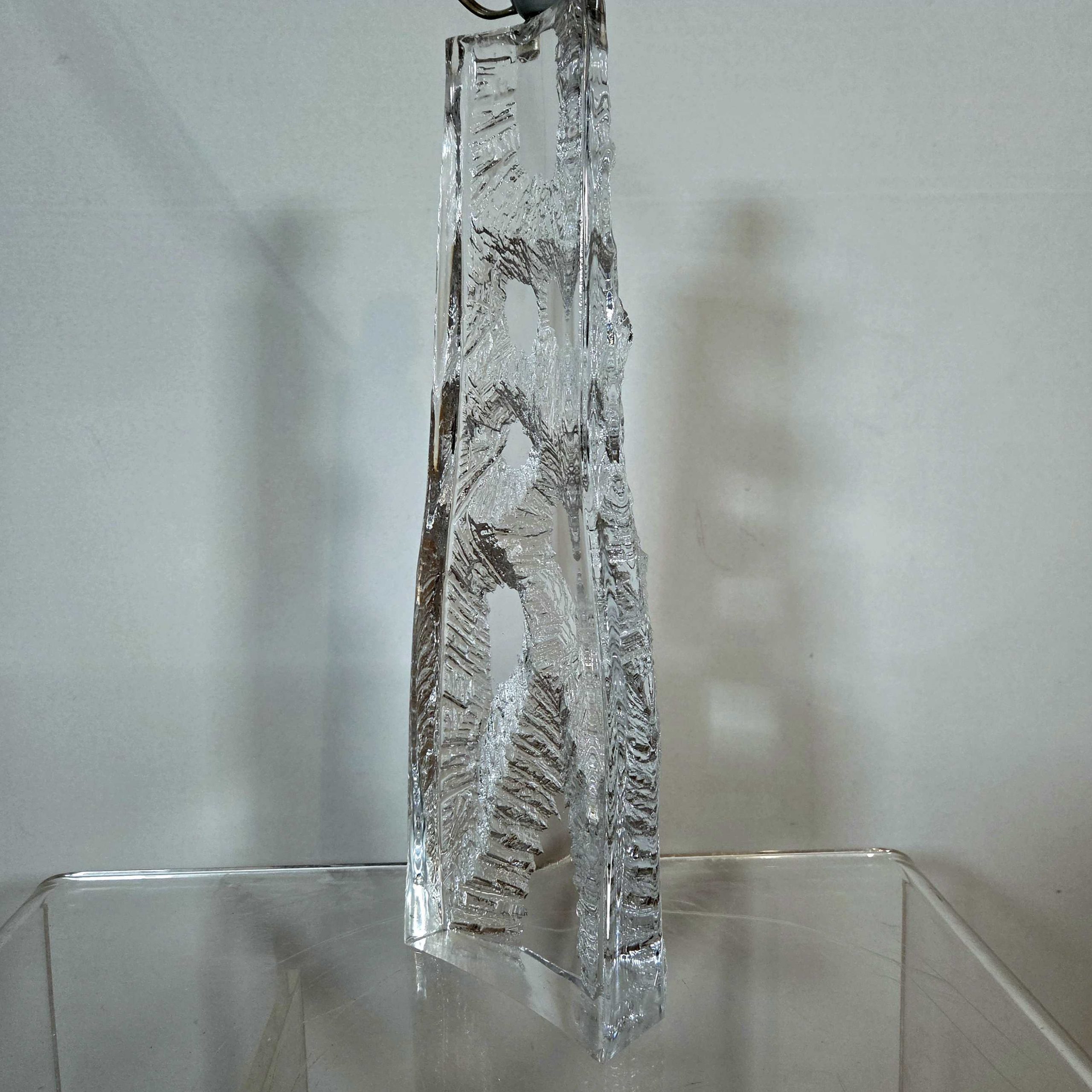
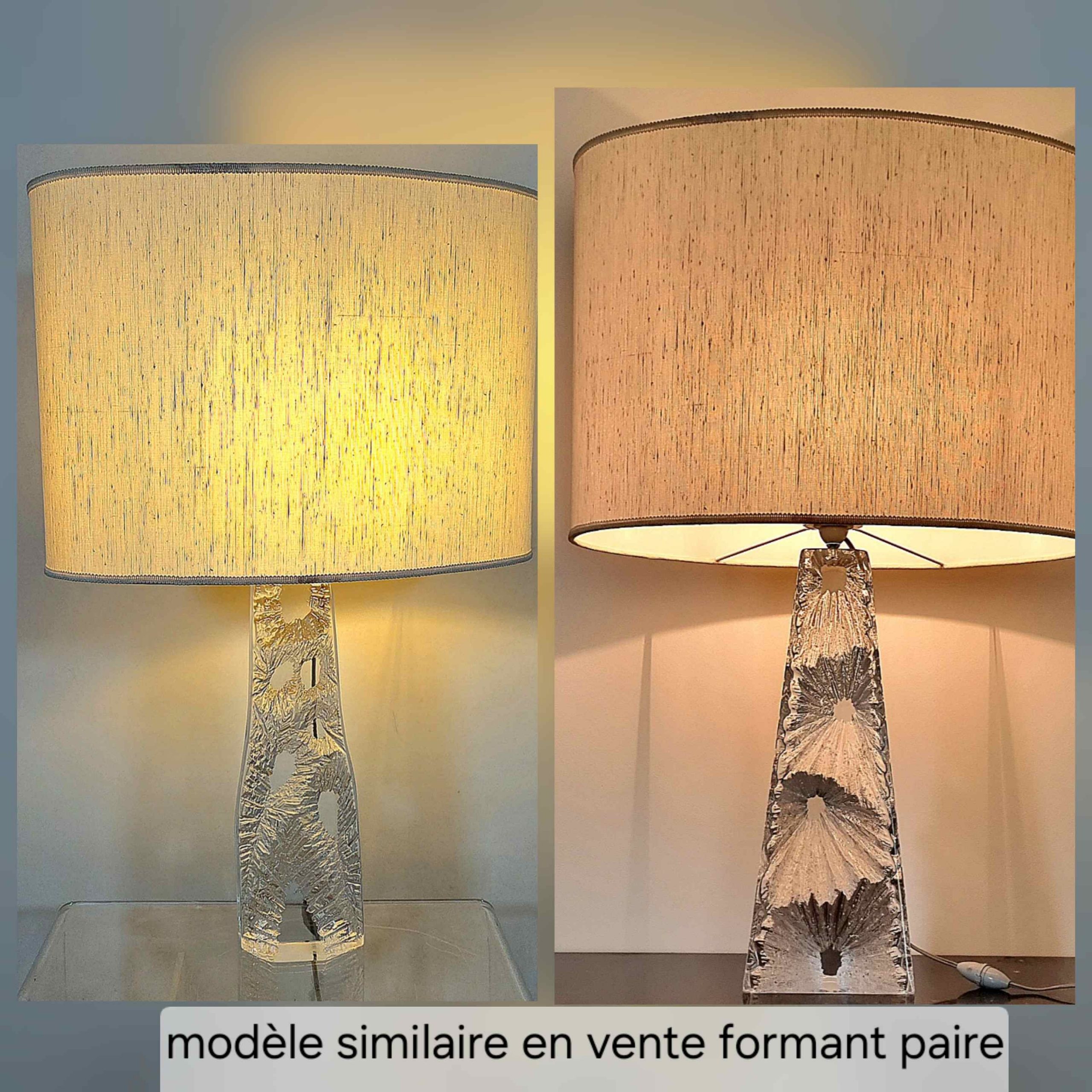
Daum, crystal lamp, Craters model, around 1960/1970
Description
What I like
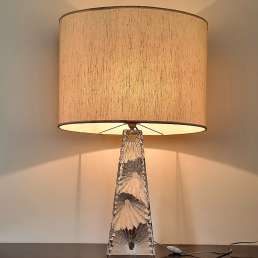
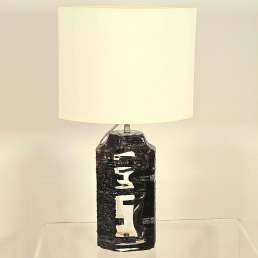
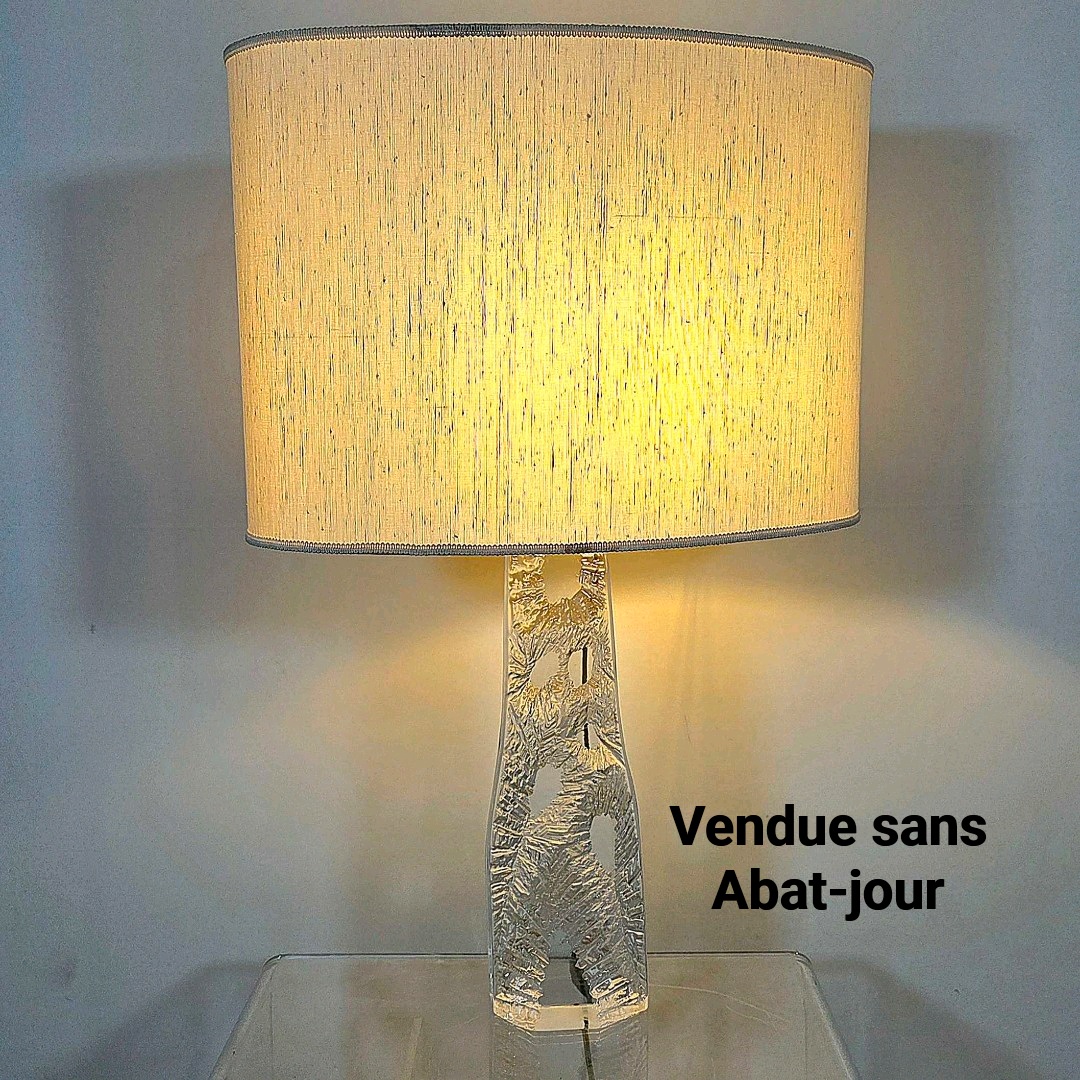
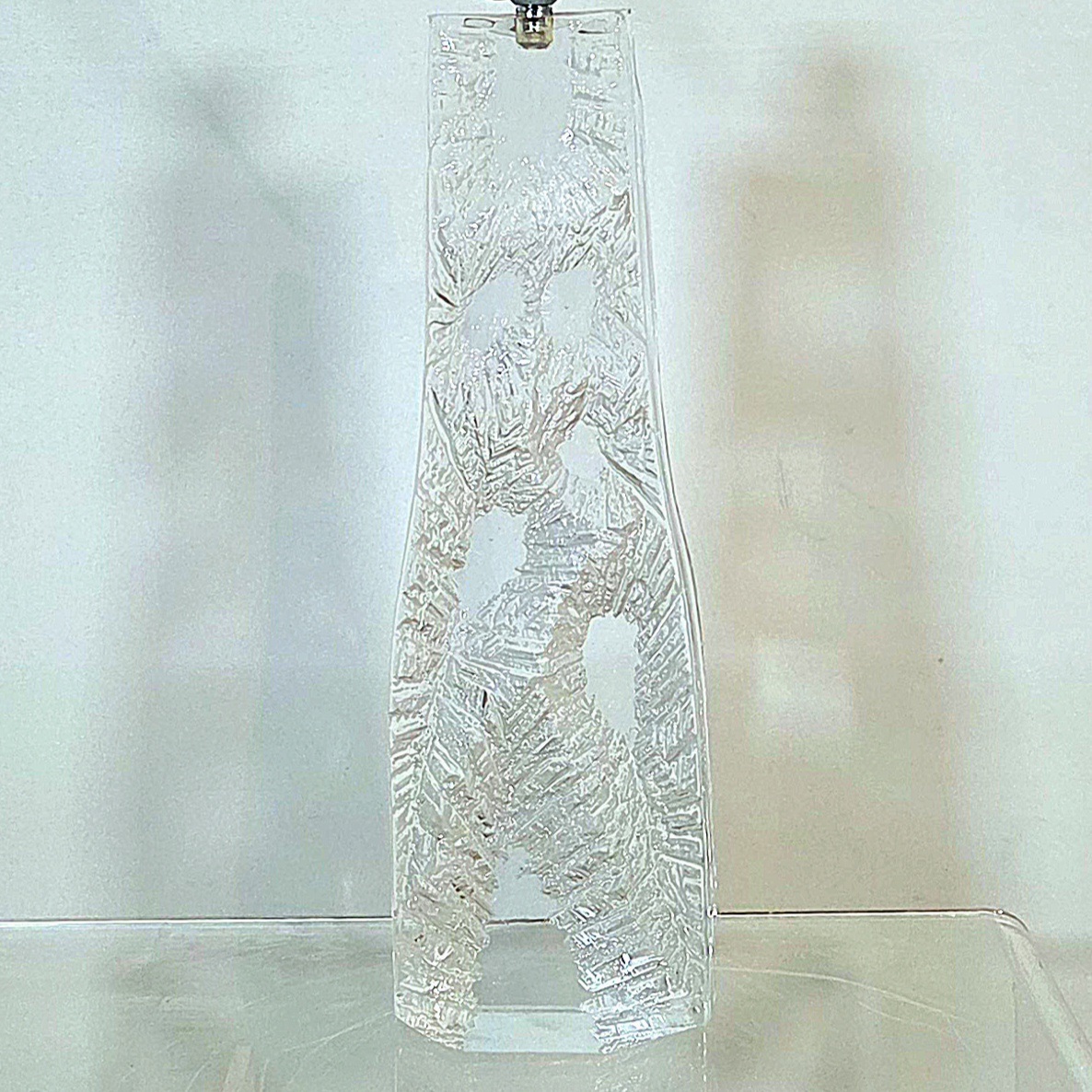
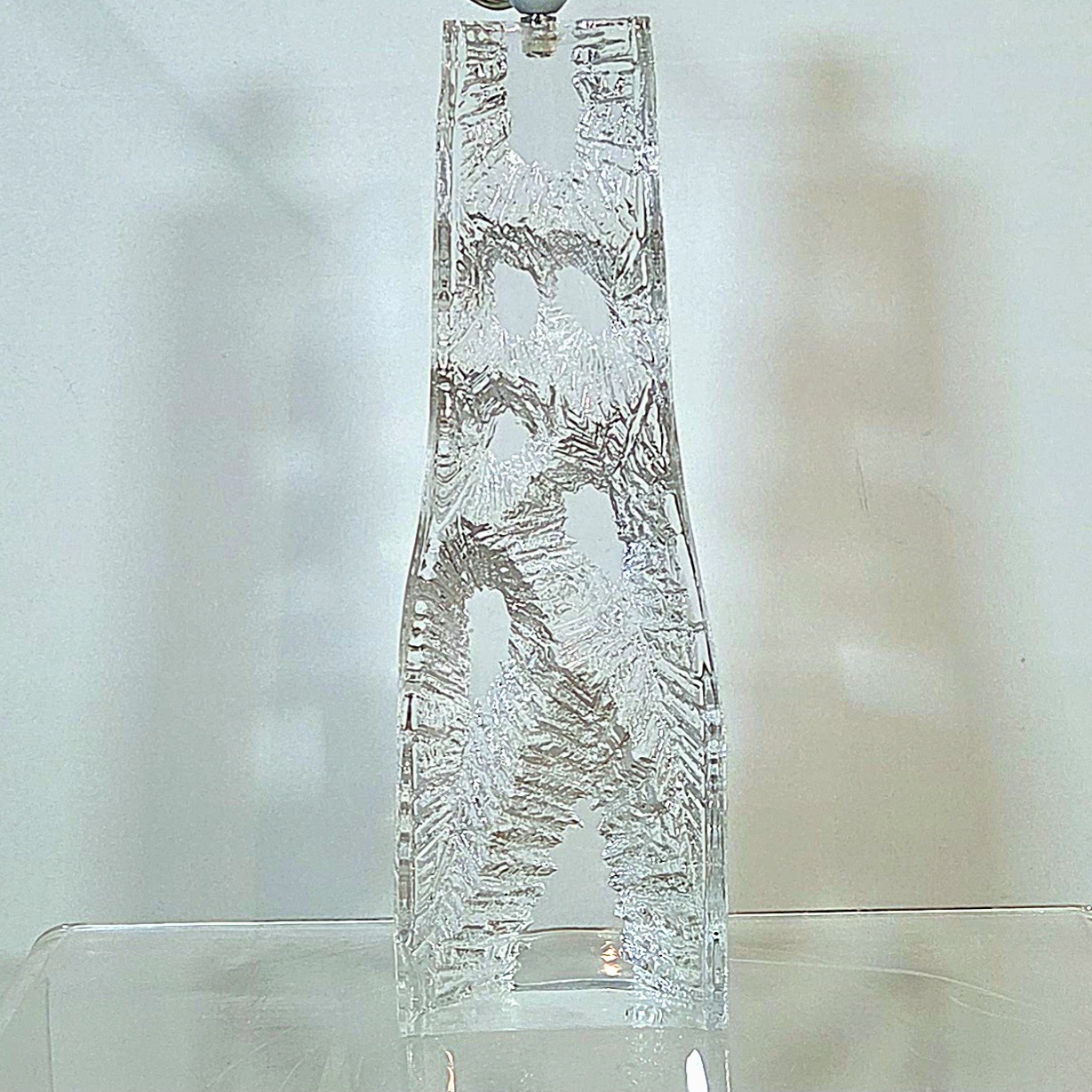
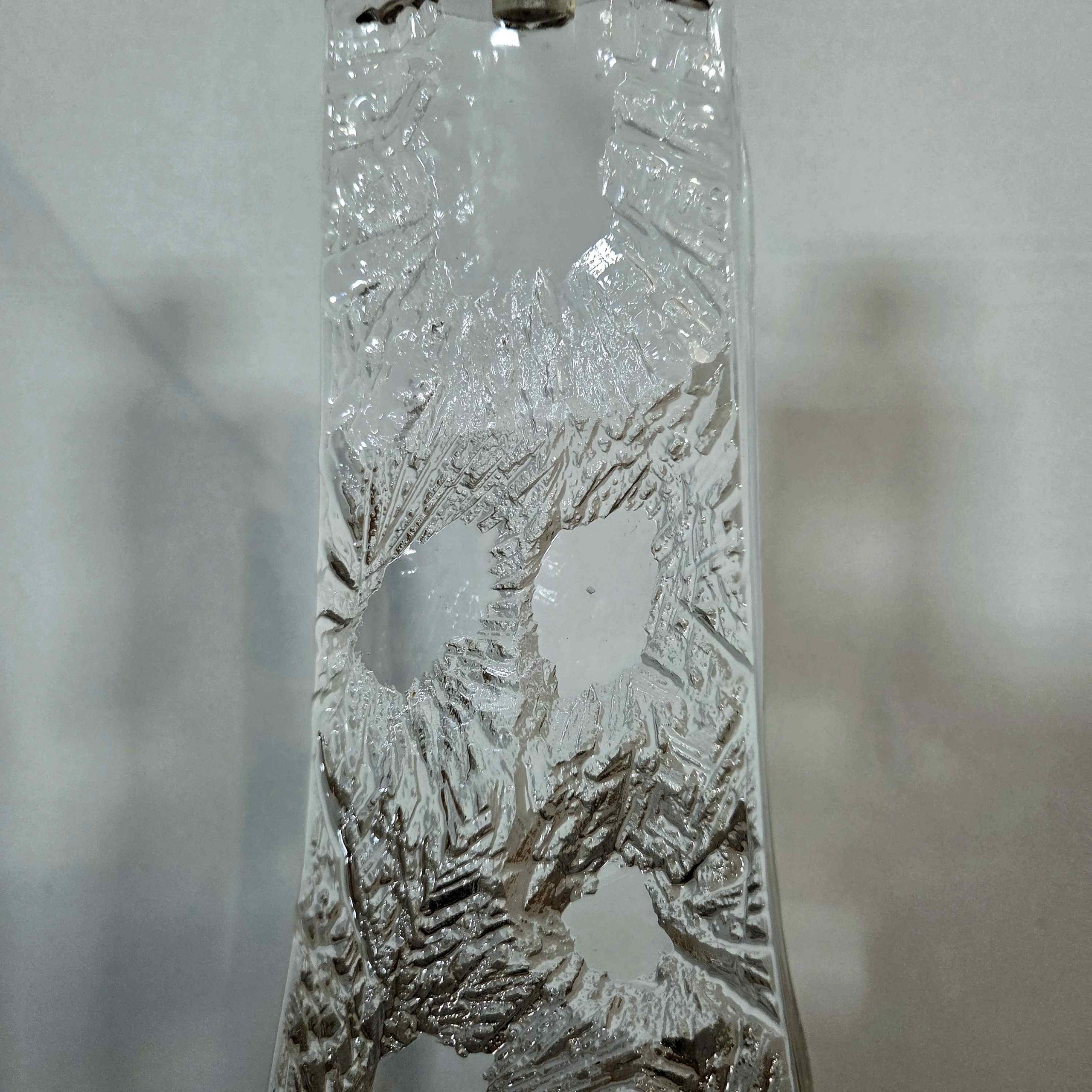
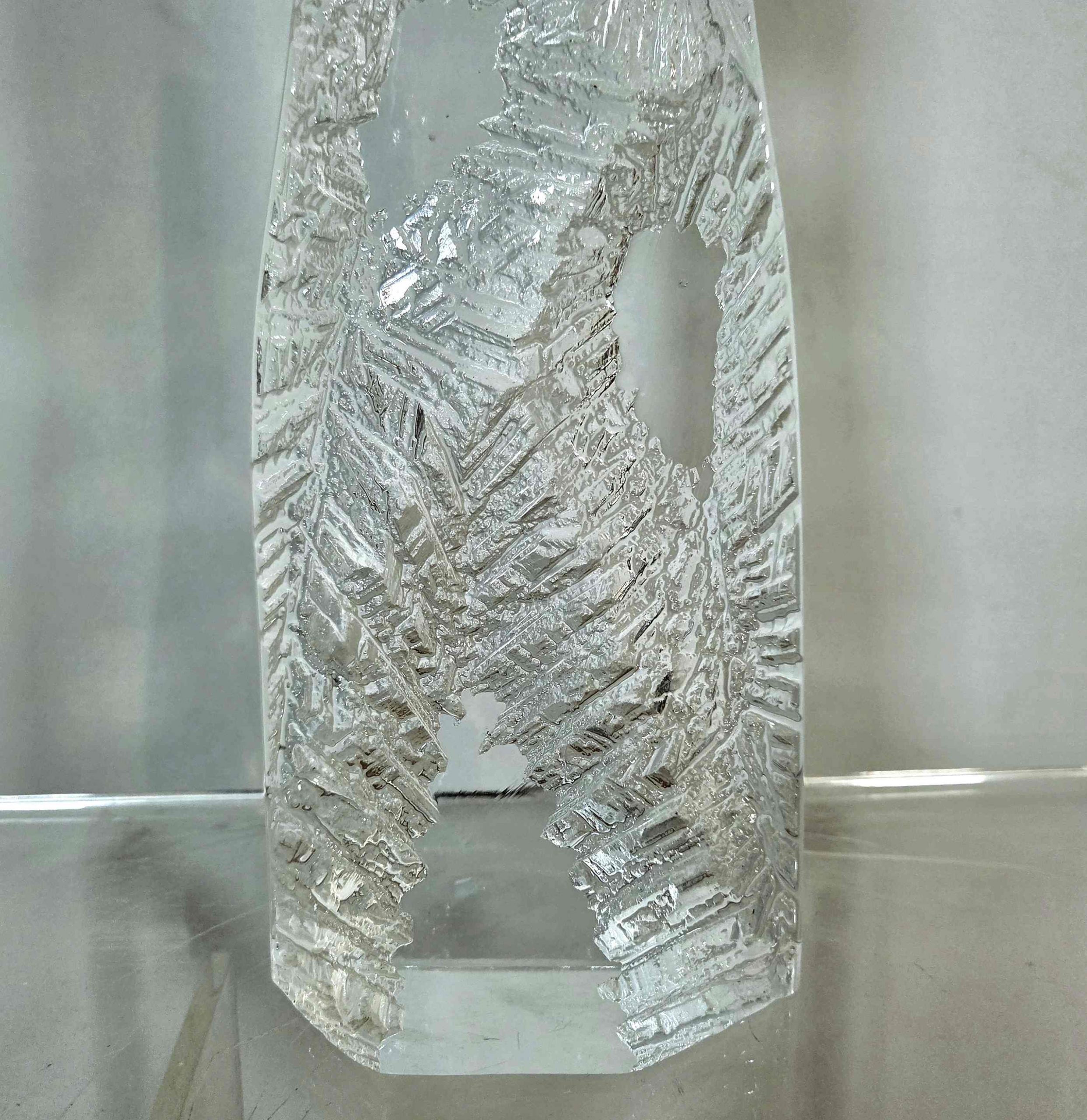
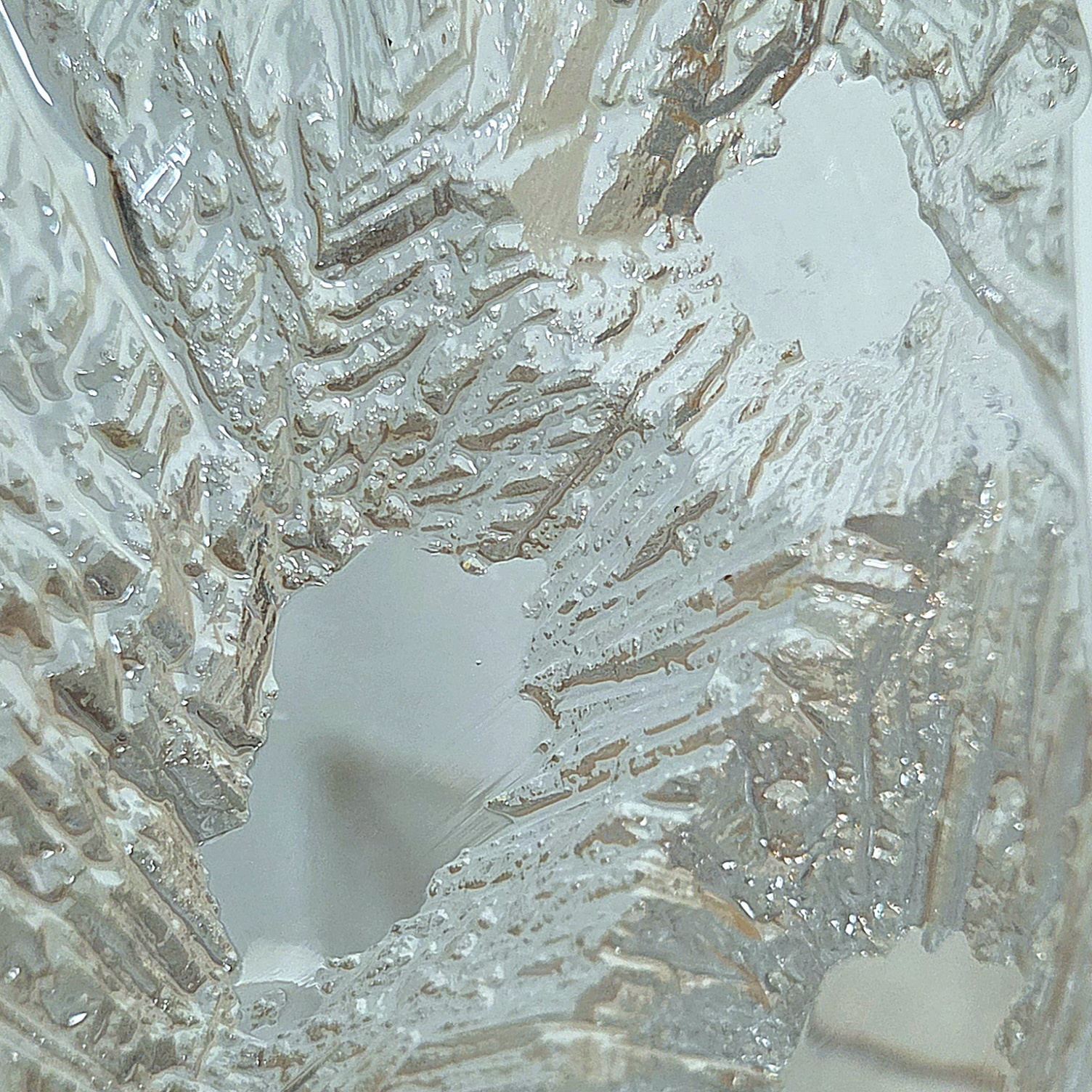
What I love about this very typical lamp is its strong 1960s/1970s style: the great house of Daum decided to make it a true sculpture, visible from all sides! The flat surface reveals nothing less than craters of distant galaxies: the decoration embraces the then-emerging space conquest. If you look at it from its other sides, you can examine the crevices of these mountains and be captivated by the phenomenal mastery of molded crystal, probably finished cold.
Moreover, I love the fact that you can change the direction of the lamp, renewing the interplay between the two sculptures and evolving the decoration of each interior, whether with the unreal look of cavities or that of small mountains!
How can you not admire, finally, the feat of its size and craftsmanship! It is a magnetic object, the pinnacle of vintage decor.
What I also really like is the elliptical shape of the original lampshade that has been preserved, which describes the revolution of a planet around a star: we stay within the realm of astronomy!
I love the fact that our home also offers a second lamp of the same ‘Cratères’ model, the same size but with three faces instead of six. You can, of course, have two lampshades made according to the model, as the two lamps share just one lampshade!
Technical description
Daum-France
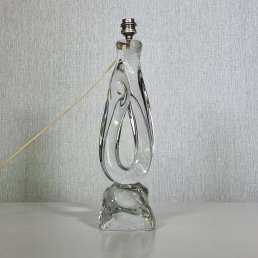
Molded crystal lamp finished with a wheel, Craters model, around 1960/1970, featuring a sort of obelisk with three flat sides and three sides with relief of 7 volcanoes, visible from the main flat side showing 7 complete or partial craters.
Unsigned.
(a few scratches under the base – minor defect at the socket attachment)
It has retained its original elliptical lampshade in textured silk bordered with trim (small stain on the trim).
Dimensions and weight
Crystal height: 40 cm, with socket: 45 cm
Width: 13 cm – Depth: 8 cm
Lampshade: Height: 34 cm – Width: 49 cm – Depth: 27.8 cm
Total height: 75 cm
7.5 kg
Mix & Match
Certainly, this is a 20th-century antique, dating from the 60s/70s: but above all, it is a sculpture! Moreover, it is an extremely contemporary sculpture: the stars are more relevant than ever, especially if Elon Musk takes some humans to Mars!
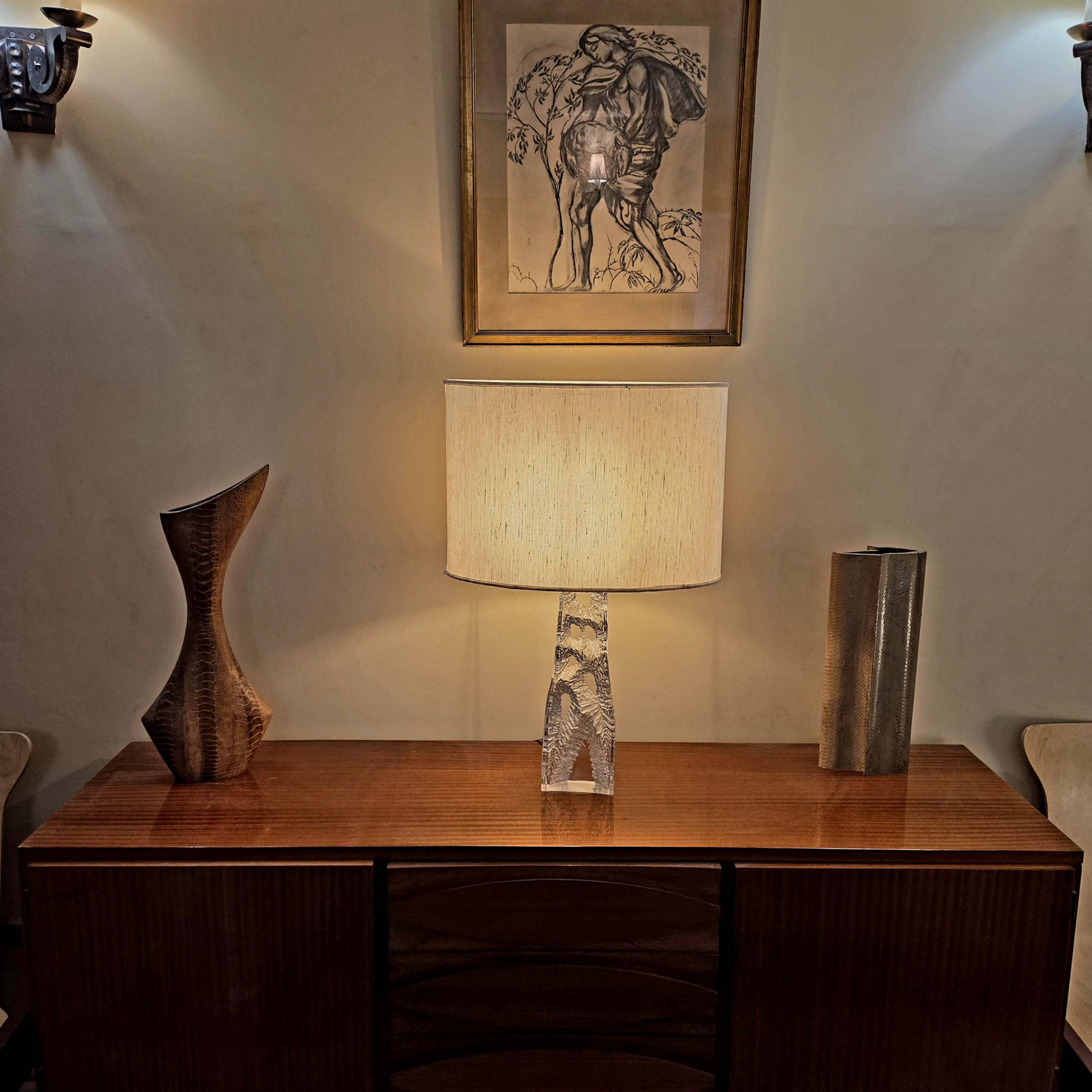
The precision of its geometric shapes will recall the angles of Philippe Parent’s Adirondack chairs: the same delicacy characterizes them; the lines of Sonja Wasseur’s Grass Hopper chair pair will also resonate brilliantly with it!
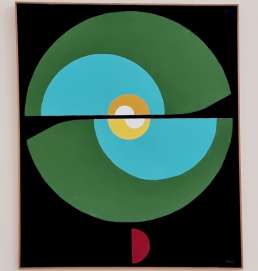
Of course, this lamp will converse with the most varied paintings, bringing its cheerfulness, its magical, cosmic quality, its volumetric dimension: I am particularly thinking of Edgard Pillet’s work, whose rigor becomes poetic, but also Enrico Cervelli’s gouache “Africano Uno” from 1961, whose status as an ochre icon will radiate the crystal of our lamp.
Its angularity will play with the curves of Naum Knop’s ‘Adam and Eve,’ and the warmth of the exotic wood in this sculpture will interact with the light trapped in the crystal of our lamp!
Finally, one can certainly consider it typical of the 60s or 70s, but one could also label it as a precious antique and place it on a Louis XV marquetry chest, or view it as a contemporary sculpture and introduce it into the apartment of a contemporary art collector!
Lastly, if you choose to succumb to purchasing the lamp from the same ‘Cratères’ range that we also offer, having two Daum lamps with the same inspiration and size will obviously be an advantage in creating a dialogue between these two sculptures that respond so well to each other.
In stock
Description
To know more
The designer
Michel Daum (1900-1986), a chemical engineer, directed the Daum crystal works alongside Henri Daum from the 1950s and became its President in 1965. A member of the Committee of Decorative Artists, he initiated the production of clear crystal pieces and, in rare cases, slightly colored ones, which are very characteristic of the 1950s-1970s. Daum’s creations were often imitated but never matched. He and his successor Pierre de Chérisey would move towards collaborations with renowned sculptors. A little earlier, the Daum design laboratory produced brutalist works, where the crystal was cut and crafted, like the Argos models, which were mistakenly attributed to César but whose authorship indeed belongs to the in-house design studio.
The editor
Daum is a glasswork company founded in 1878 in Nancy, Lorraine, France, by Jean Daum. The development of Daum took place around 1890-1900 with the Art Nouveau style and the École de Nancy (cf. Gallé…). The creations from this period populate museums, both in France and in Japan, the United States, and Japan in particular. The Daum workshops trained some of the great names of Art Nouveau: Jacques Gruber, Amalric Walter, the Schneider brothers… Masterpieces were also created during the Art Deco period, also featured in major museums. After World War II and the numerous shortages of pigments used to make glass paste, crystal took a predominant place, under the direction of Henri and Michel Daum. A grandson of the founders developed a particularly transparent and brilliant crystal. This new crystal facilitated the production of pieces with thick, supple shapes and a luminous appearance. At that time, pieces that were true sculptures were also developed: in crystal paste, in crystal, colorless or enamelled. One naturally thinks of the iconic “Argos” series, which was long mistakenly attributed to César: certainly, the latter worked with Daum, but the Argos series, like the Cratères series, was created by the in-house design office!
A beautiful and authentic Daum crystal Craters lamp at a fair price
This Daum Crystal Craters lamp has been carefully selected for its aesthetic qualities, its originality, and its fair price. Our choice prioritizes above all the sharpness of the design, guaranteed by Michel Daum’s signature, as well as the quality of execution, here certified by the perfection of Daum crystal, ensuring the value of your new acquisition in your home and its ability to harmonize with your furniture, to blend and mix to create a unique decoration.
Buying vintage lamps is certainly a sensible investment, given the strong appetite for the 1960s/1970s and the continued interest in pairs for interior decoration.
Finally, purchasing a vintage Daum lamp conserves the Earth’s resources.
Additional information
| Weight | 7,5 kg |
|---|---|
| Dimensions | 13 × 8 × 40 cm |