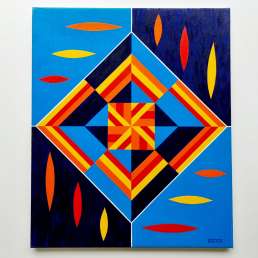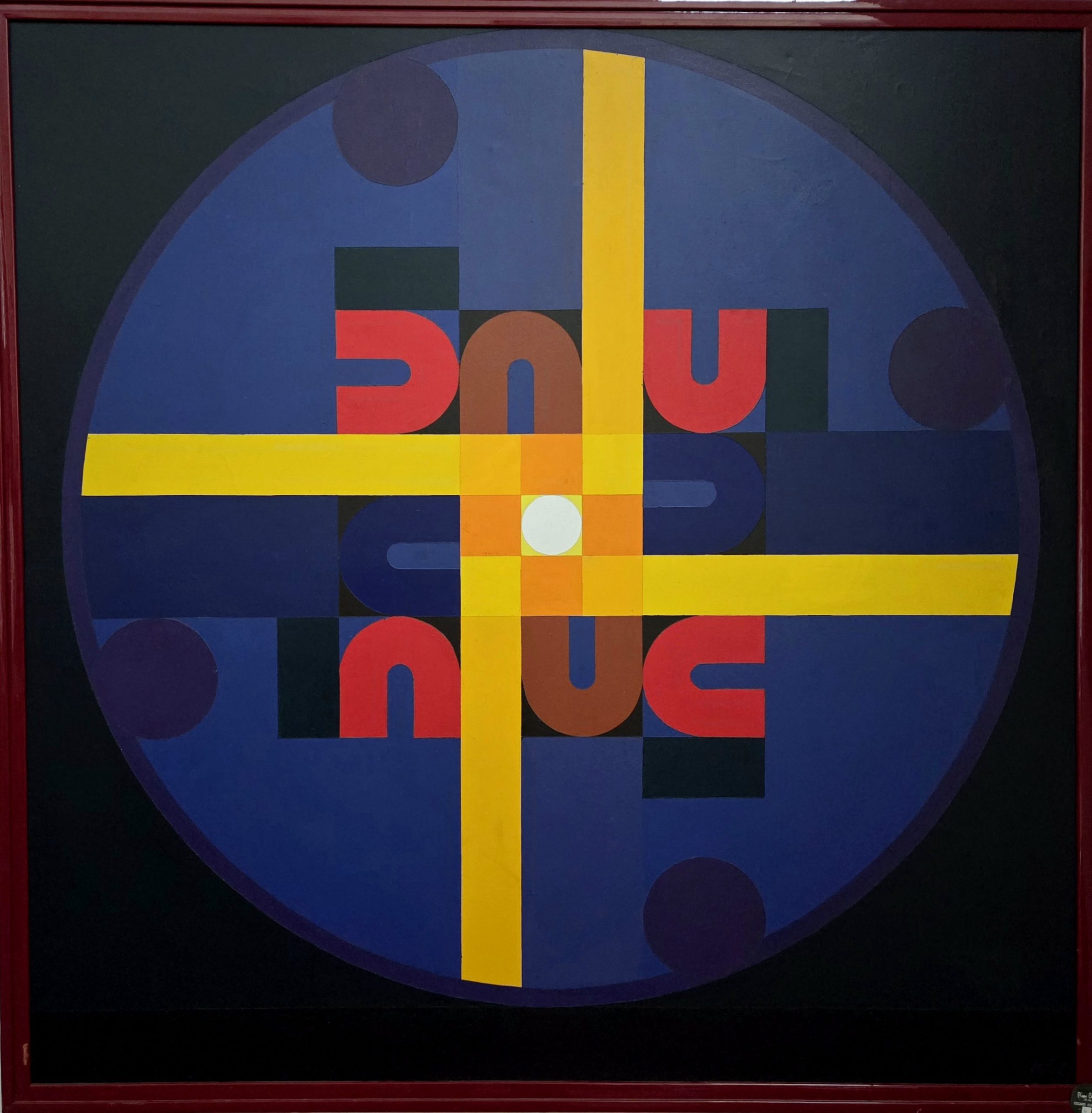

Enrique AHIL (1926-2002), Groupement I, 1972
Description
What I like
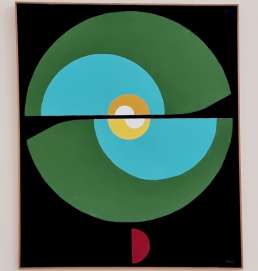
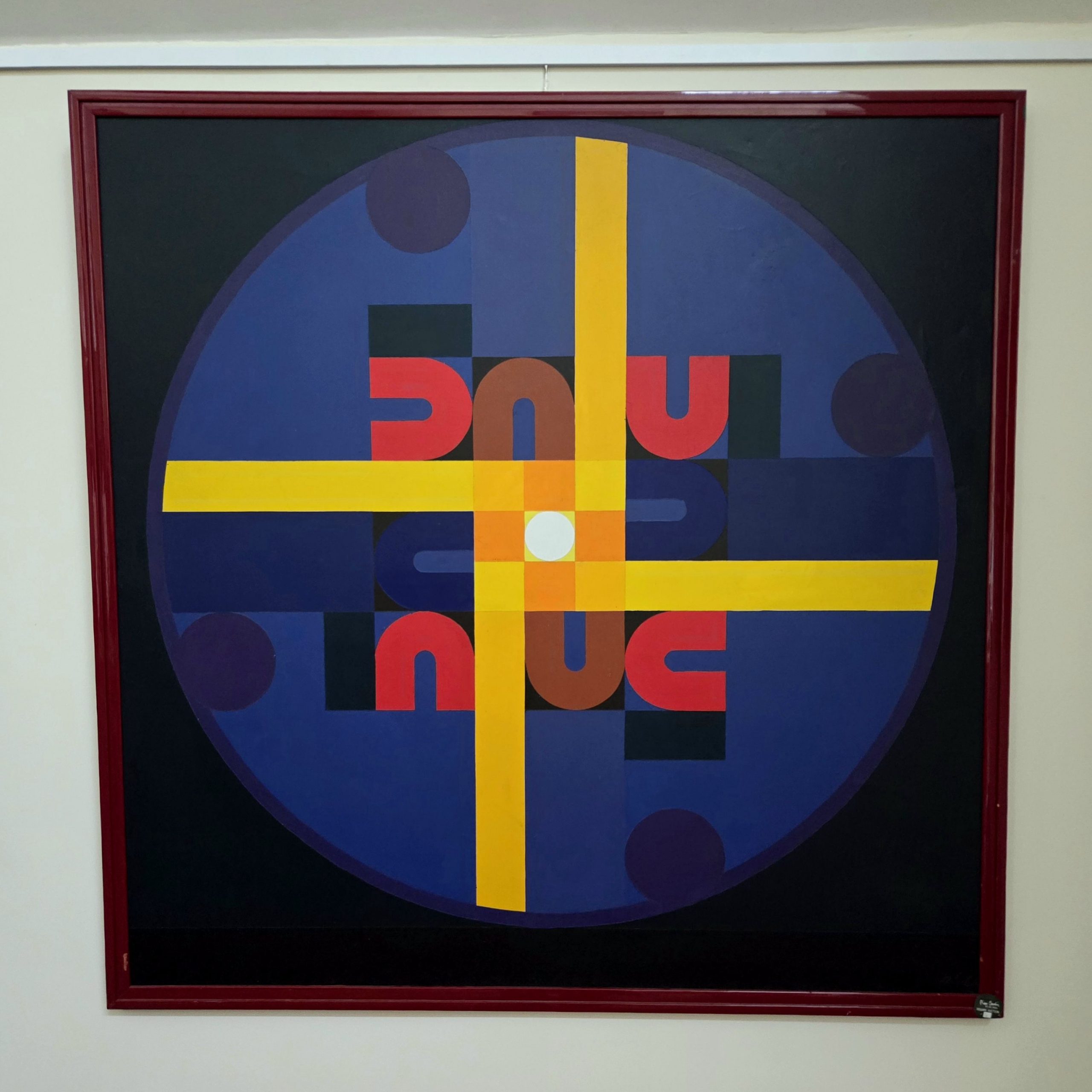
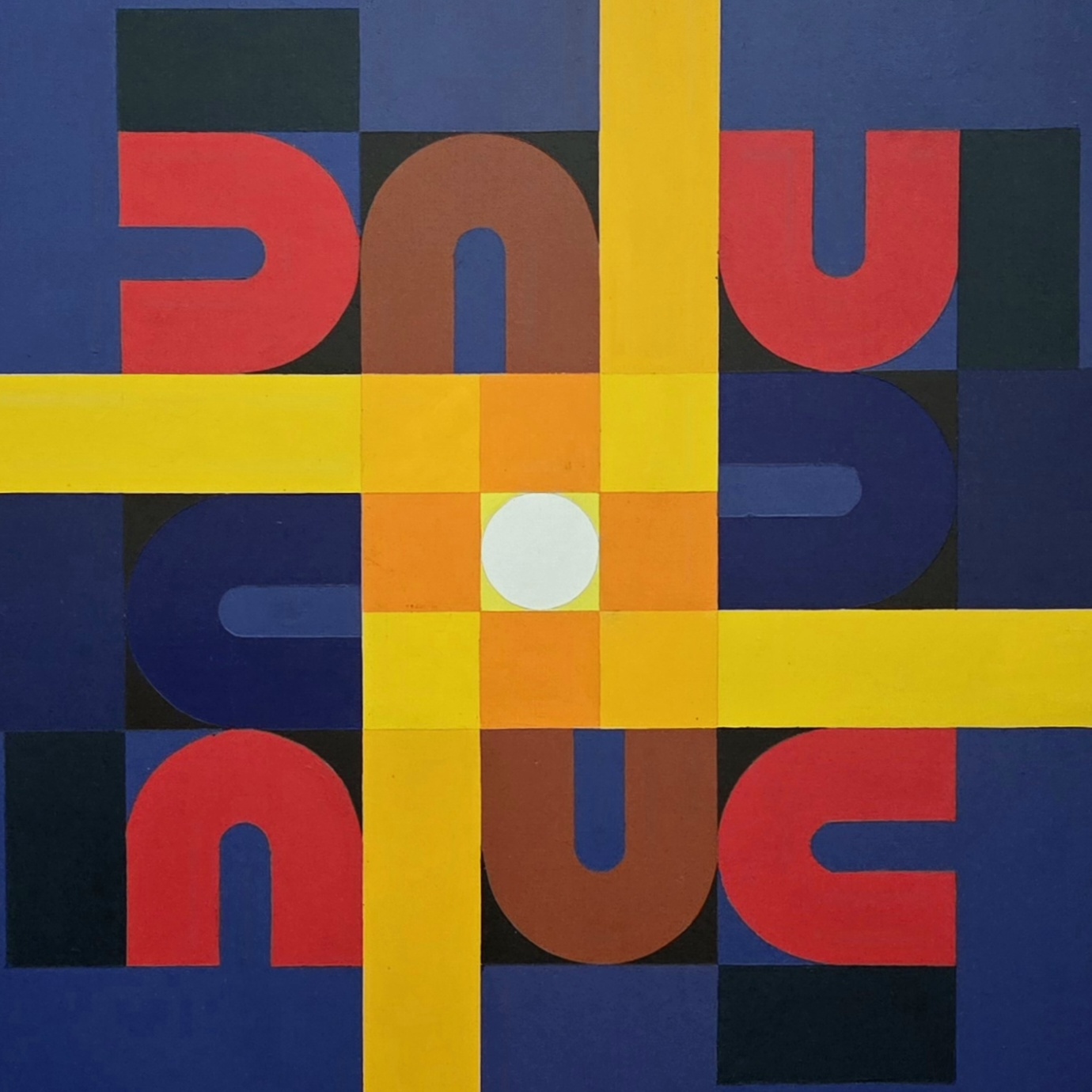
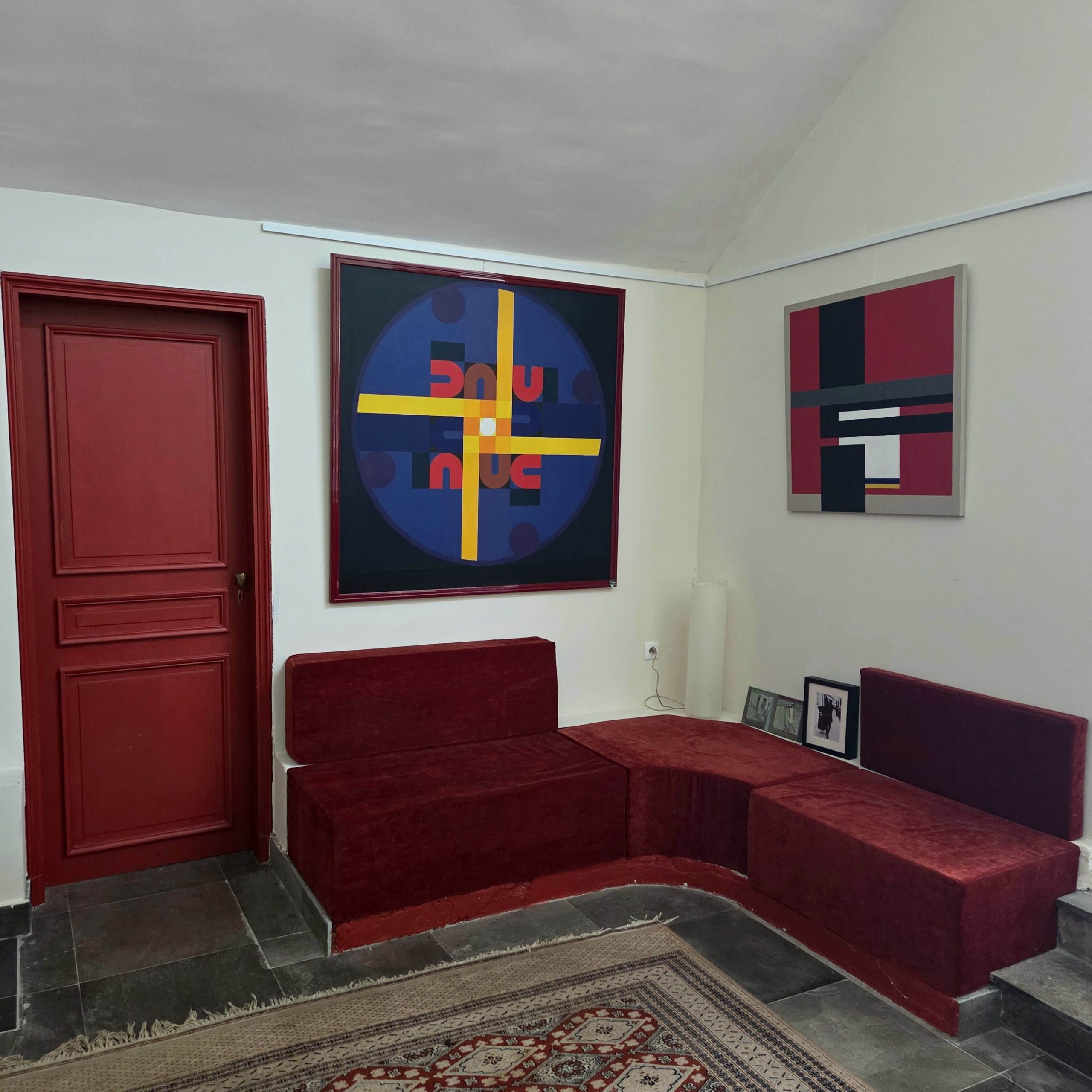
What I love most about this work by AHIL is its eminently cheerful, energizing character: the colors are vibrant: bright yellow, blue, orange, red, and purple. But they are anything but simple: while the colors are flat, the hues are varied: bright yellow, a slightly lighter shade, orange, light orange, and various blues; the palette transitions from the blue-black of the border to the pure white of the center. Above all, these diverse colors form very dynamic patterns, like the bright yellow four-bladed propeller, immediately balanced by the red U-shaped or inverted U-shaped motifs, and especially by the four purple circles touching the main circle, slowing its rotation! Truly great art…
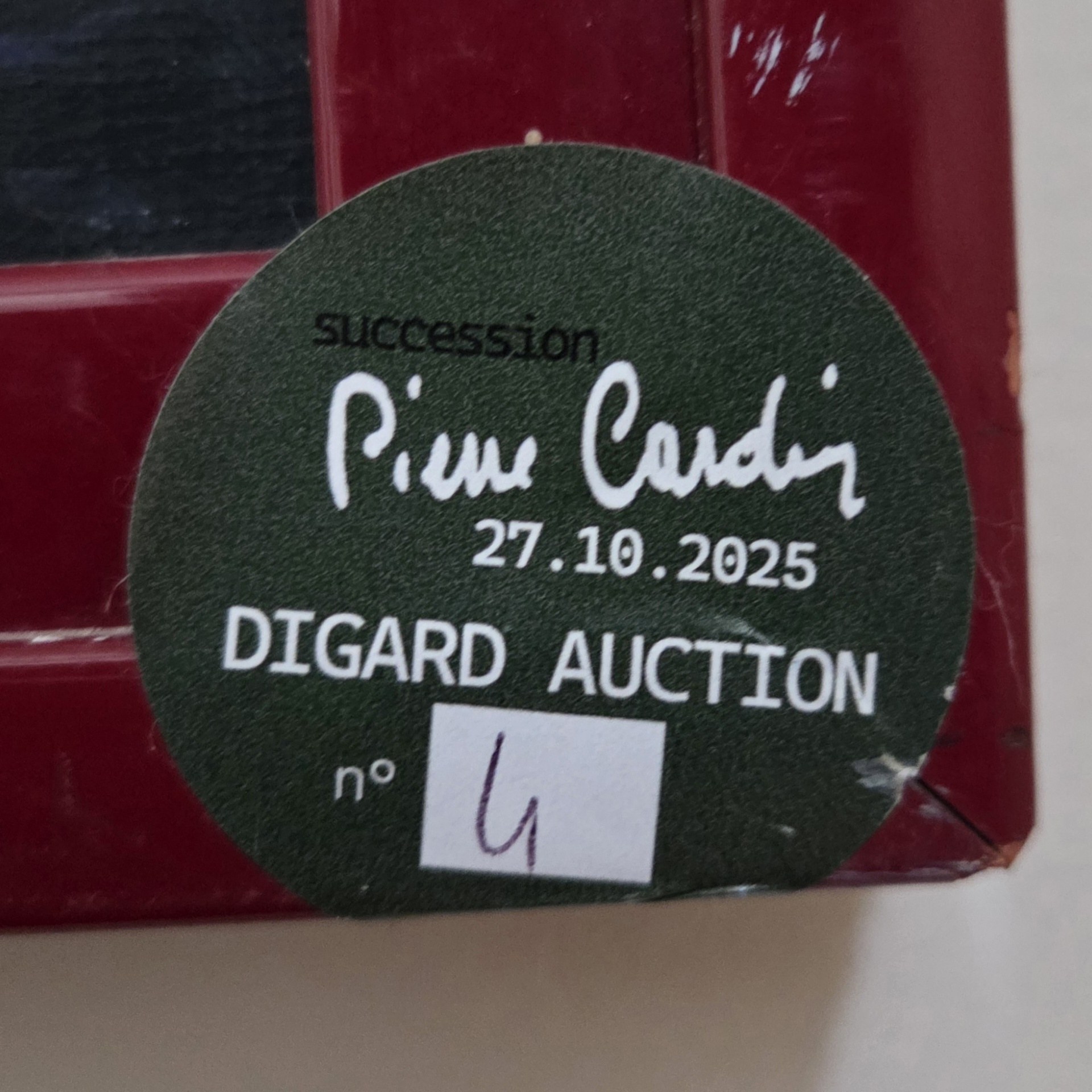
I appreciate that Enrique Ahil is a relatively unknown painter, although his works are sold at auction around the world; But above all, this painting was chosen by Pierre Cardin, the avant-garde designer who developed a visionary, somewhat spatial, and always extremely geometric style of fashion, as well as architecturally inspired furniture, thus creating the 1970s style as we know it. Indeed, this painting comes from the sale of his estate, and we have carefully preserved the sales labels, commemorating its inclusion in a diverse collection that naturally includes many works (furniture, paintings, etc.) that are extremely typical of the 1970s.
Finally, I love this painting for its large size: 120 x 120 cm. It truly enlivens a wall and gives you a boost of energy first thing in the morning!
Technical description
Enrique AHIL (1926-2002)
Groupement I, 1972 (Group I-1972)
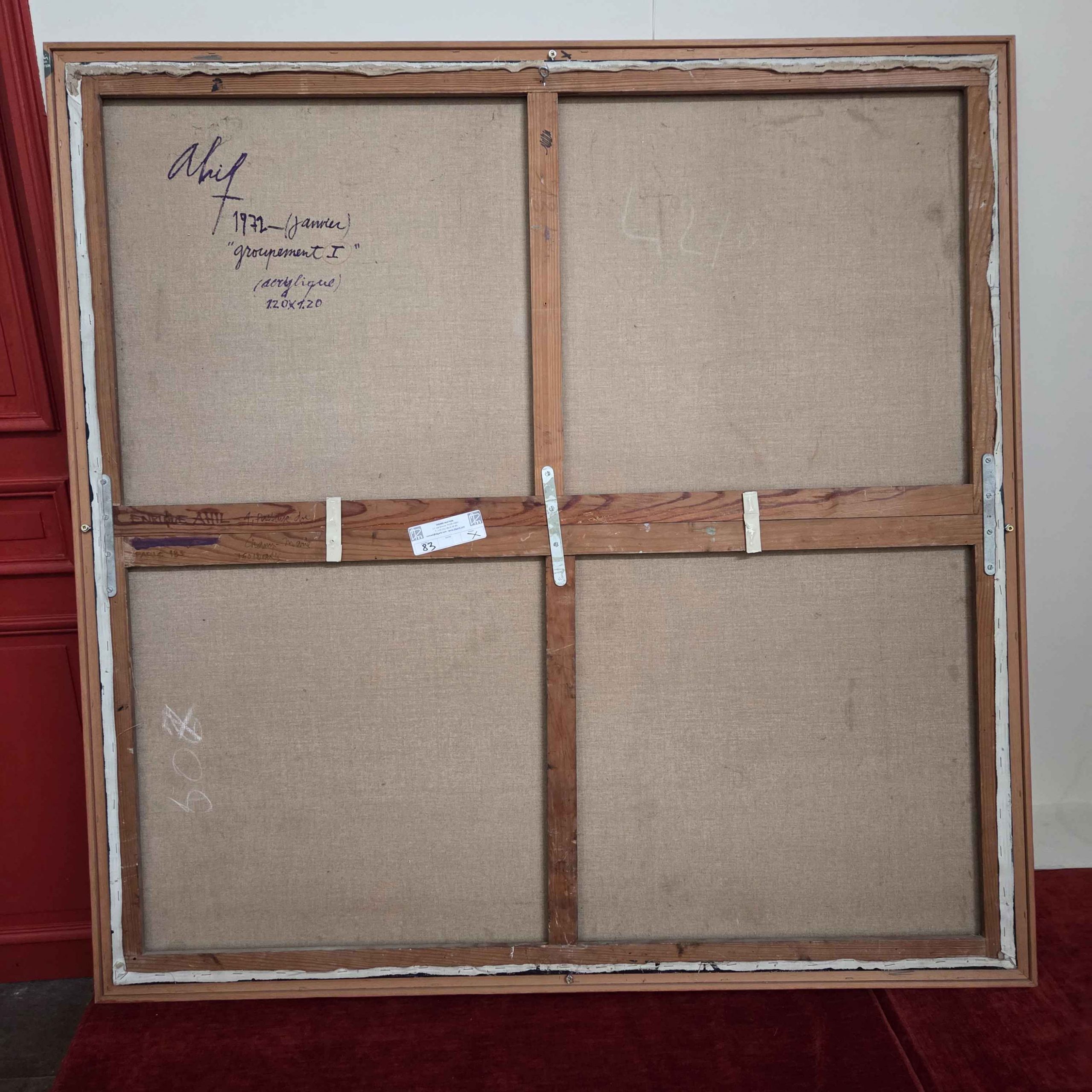
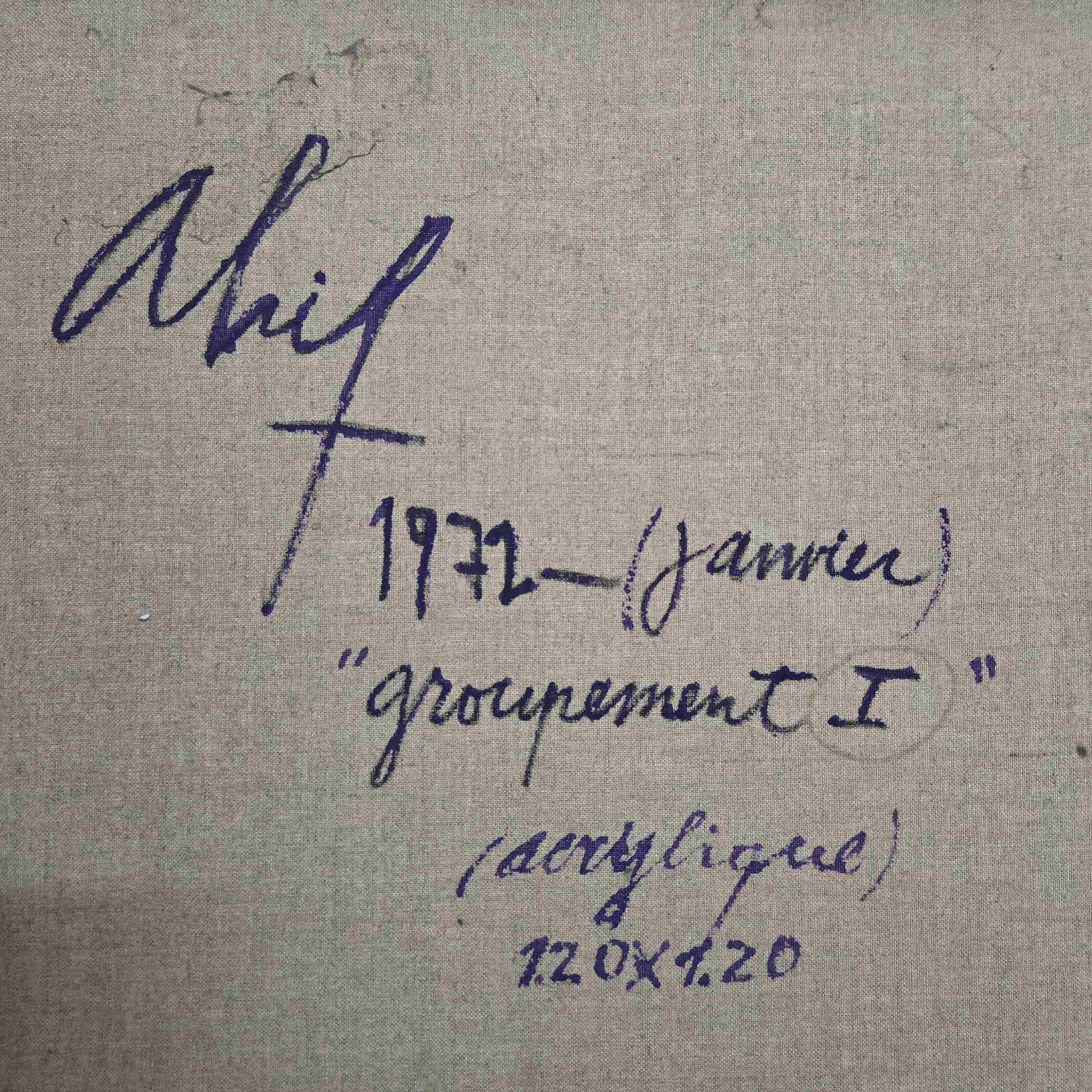
Acrylic on canvas, signed, dated, and titled on the reverse.
Present auction house labels from Digard Auction, “Pierre Cardin Estate,” on the dark red lacquered metal frame (minor losses to the lacquer).
Dimensions and weight
Height: 120 cm – Width: 120 cm – Depth: 5 cm
Weight: 8 kg
Mix & Match
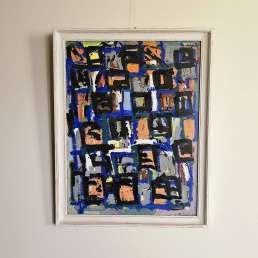
This painting by Enrique Ahil is a manifesto of geometric abstraction as it developed in the 1970s. As such, it would be well suited to be displayed alongside other paintings of this style: I am thinking of Edgar Pillet’s Composition, circa 1950/1951, which explores black, green, blue, yellow, and red, but also Michiel Gloeckner’s Aquarius (1973), with its more muted hues, or Lenine De Lima Medeiros’s Geometric Abstraction (Milano, 1971), which echoes the black, blue, green, and yellow of Ahil’s work.
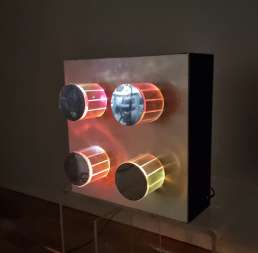
Alongside it, I would gladly show Marthe Boto’s Dynamo-Chromatique from 1969, a luminous kinetic work so perfectly in tune with its time, from the Denise René Gallery.
If I were to include tapestries, why not Jean-Paul Philippe’s Composition (1974), in aniline-dyed velvet? Or perhaps the large Composicion Metallica by Enrique Broglia, with its brass fins, so typical of the late 1960s!
For the furniture, I would play with color: obviously the pair of G10 armchairs by Pierre Guariche and their duck-egg blue wool upholstery, slightly earlier, or the spherical sofa in orange fabric attributed to Carl Eric Klote, with its strikingly architectural forms.
The two Adirondack chairs by Philippe Parent, also geometric but in green, would fit perfectly into this interior!
Description
To know more
The painter
Enrique Jose AHIL: Born in Campana, Buenos Aires Province, on January 13, 1926, he died in Paris on January 28, 2002. He studied at the Ernesto de la Cárcova Higher School of Fine Arts under the direction of Enrique de Larrañaga, graduating with a degree in drawing in 1953. He taught drawing in institutes and schools throughout Buenos Aires Province. He won third prize at the Campana Salon in 1948 and first prize in the drawing competition of the University Circle and the Municipal Salon of Campana in 1957. In 1959, he emigrated to Spain, then to Germany, and finally to France, where he lived in Paris until his death. His work was recognized throughout Europe. He participated in national and provincial exhibitions and was known as “the painter of Paris.” Considered by Córdova Iturburu to be a transitional artist between pictorial traditionalism, as evidenced by his artistic production in Argentina, and his later evolution toward the avant-garde, culminating in Paris with complete geometric abstraction bordering on kinetic art. His work is cold and decorative, focused solely on color and material, on arabesque and nuance. (Córdova Iturburu, La Pintura Argentina del Siglo XX, Editorial Atlántida Colección Oro, Buenos Aires 1958. Diccionario de Artistas Plásticos en la Argentina de Gesualdo, Biglione y Santos, Editorial Inca, Buenos Aires, 1988.)
A beautiful and authentic painting by Enrique AHIL at a fair price
This artwork by Enrique Ahil has been carefully selected for its aesthetic qualities, originality, and fair price. Our choice prioritizes above all the artistry of the piece, guaranteed by Enrique Ahil’s signature and its provenance from the Pierre Cardin estate. This ensures that your new acquisition will enhance your interior and will complement your furniture, blending seamlessly to create a unique décor. Buying paintings from the 1970s is certainly a sound investment, given the enduring appeal of this era. Finally, purchasing 70s art helps conserve the Earth’s resources.
Additional information
| Weight | 8 kg |
|---|---|
| Dimensions | 120 × 120 cm |